
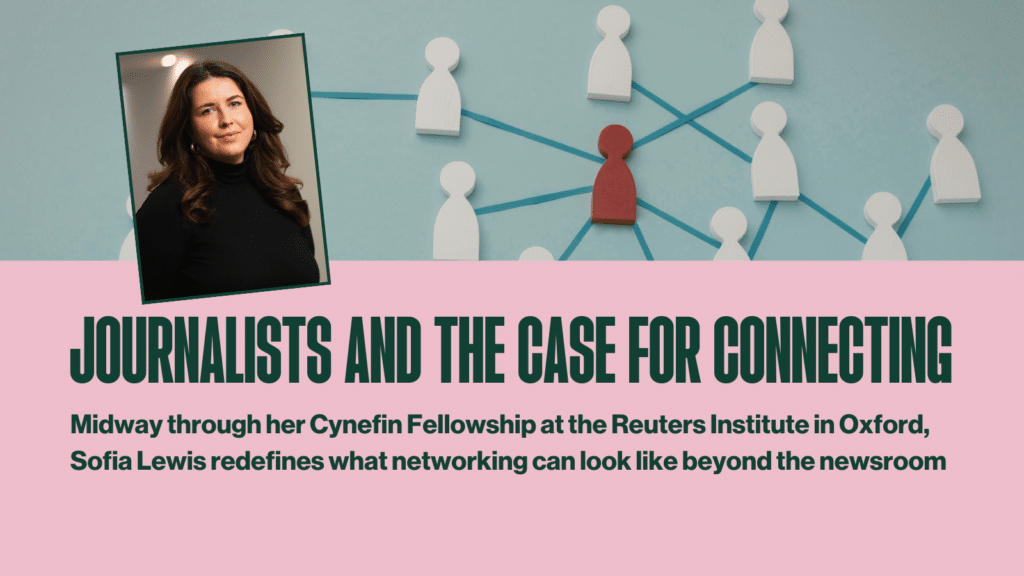
Back in December, we were delighted to announce Sofia Lewis as the recipient of our inaugural Cynefin Fellowship. As part of the fellowship, Sofia is spending a term at the Reuters Institute in Oxford, exploring the future of journalism alongside six other Fellows from around the world. This is the first in a series of blog posts Sofia will be sharing with us about her experience. This project has received support from the Welsh Government via Creative Wales.
As a journalist working in broadcast, it’s rare to get an opportunity to take a step back.
The demand of the daily news output – in my case, multiple television bulletins, a streaming service, social channels, and a news website – means that you’re constantly on a coffee-fuelled hunt for the next story.
And while it can be one of the most exciting and rewarding careers for that very reason, there’s a risk of being so focused on what’s next that you lose sight of why the storytelling matters in the first place.
I’m Sofia, a broadcast journalist working at ITV Wales in Cardiff.
I’ve been glued to news and current affairs for as long as I can remember – well before it was part of my job description. Yet growing up in Port Talbot, a small, industrial, working-class town, it often felt like the headlines about our community were shaped by those with little understanding about the realities of life there.
That disconnect played a major role in why I was first drawn to becoming a journalist – to have a stake in that narrative. I wanted to platform stories that mattered to communities like mine, communities that were underrepresented, and sometimes misrepresented, in the media.
But even when you’re armed with passion and persistence, landing that first break in journalism can be a struggle for many. Between low-paid and unpaid entry-level work, the demand for expensive master’s courses, and a stubbornly London-centric industry, people from working-class and lower income backgrounds still face significant barriers to getting work.
While I did manage to secure a spot on a competitive news traineeship and find success in my early career, the reality is that my own journalistic career trajectory remains an anomaly in the industry. That’s what fuels my interest in exploring which stories get to be told, and who gets to tell them.
They are big questions… but not so easy to unpack when a daily 6pm programme deadline is looming.
Which brings me back to that rare luxury – being able to stop and take stock.