
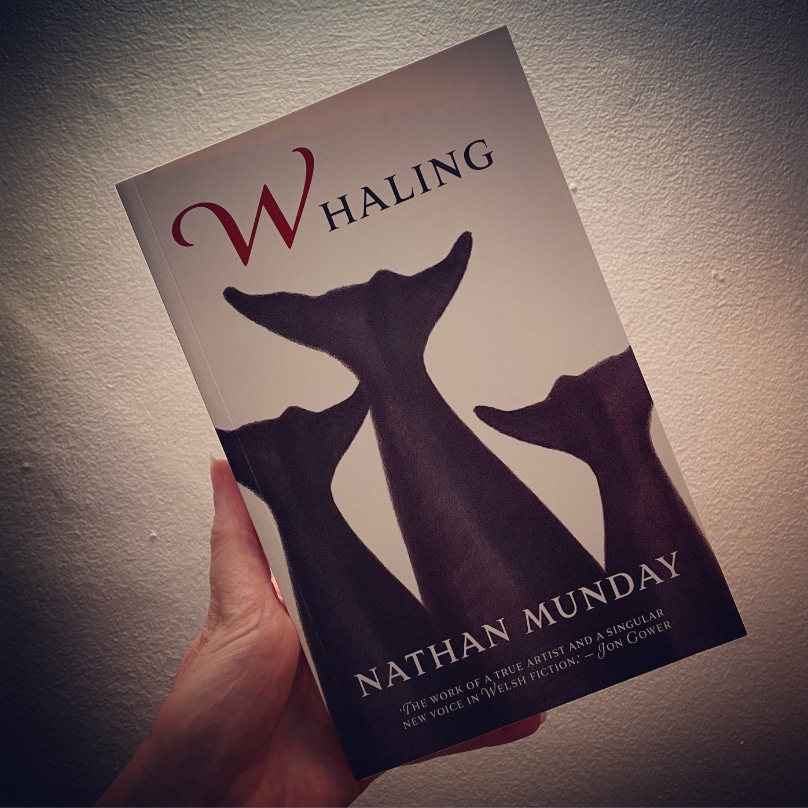
Tell us about your novel?
The whale has been well-used: whalers, writers, artists, and musicians… even God employs a great fish to swallow his fleeing prophet. Whaling re-introduces this tired animal into a historical event.
The blurb calls it a counterfactual novel: correct. Its visions (there are no chapters) form a kind of literary collage, weaving eighteenth-century truth with fiction.
Fifteen families arrive with different accents, different songs, and different ways of thinking. How would you have reacted to their arrival? Throw in an unusual, beached whale and the locals connect the two landings. The novel begins.
What inspired Whaling?
2016. Come with me to Hyannis, Cape Cod.
I’ve missed the ferry, so I buy some Ben and Jerry Minter Wonderland. I walk into the hostel dorm and a topless chap sits on the top bunk staring at me as if in a trance. I greet him. No answer. Bag down, I escape. Perusing the boats, I check the timetable repeatedly, waiting for the safety of morning.
Sunrise. I’m glad to leave. The ferry speeds through a champagne sea and saline breeze. The island appears with its yellow sand-line, white sails, chalk buildings, lighthouse, and finally, a jetty.
Entering the Whaling Museum, I spin the trinket prayer-wheel rack, noticing all the Moby tails jingling. A whale skeleton spines its way across the building as I head upstairs. In a glass cabinet, a map of Nantucket’s whaling diaspora. I read this note:
This is your debut novel, what first inspired you to become a writer?
Gallipoli, or rather I heard Tadcu talking about his father’s experience in the Dardanelles. I was sixteen and he was sixteen. He lied, fought, regretted.
I wrote.
My story, ‘Rwy’n Cofio / I remember’, won the school Eisteddfod chair. Being a shy pupil, the win gave me a burgeoning confidence with words. Usually, only sixth formers entered the competition but my Welsh teacher, Dr Non Evans, encouraged me to enter after reading my work. Diolch o galon!
How would you describe your writing?
I’m very Welsh! You’ll hear that when you meet me. Somehow there’s an unavoidable poetry that seeps into my prose. Whaling needs to be read out loud. I’ve never been bored in my life, and I think you’ll notice that when reading my work.
Which writer(s) from Wales would you recommend to readers, and why?
Read our past and present. The three grandparent figures squatting in my mind are Williams Pantycelyn, R. S. Thomas, and Ann Griffiths.
Then there’s writers like Cynan Jones, Eluned Gramich, Jon Gower, Horatio Clare, and Cynan Llwyd who manage to capture the wonder of Wales today.
What are you currently writing?
I often encounter fascinating characters and hear their stories — that’s part of becoming a Christian minister. Christ himself was often accused of being a glutton and a ‘winebibber’ simply because he took time to listen and eat with a plethora of characters. My writing is often influenced by similar conversations over meals and walks.
I was walking with my father-in-law recently and, as we crossed from one dijk to another, he told me a story about this character who lived alongside a sloot, or a small canal. Uncle Piet’s profession was unorthodox; he was one of the last of his kind (I won’t tell you what he did. You’ll have to wait for the next novel!)
Whaling by Nathan Munday is available now from your local bookshop.