
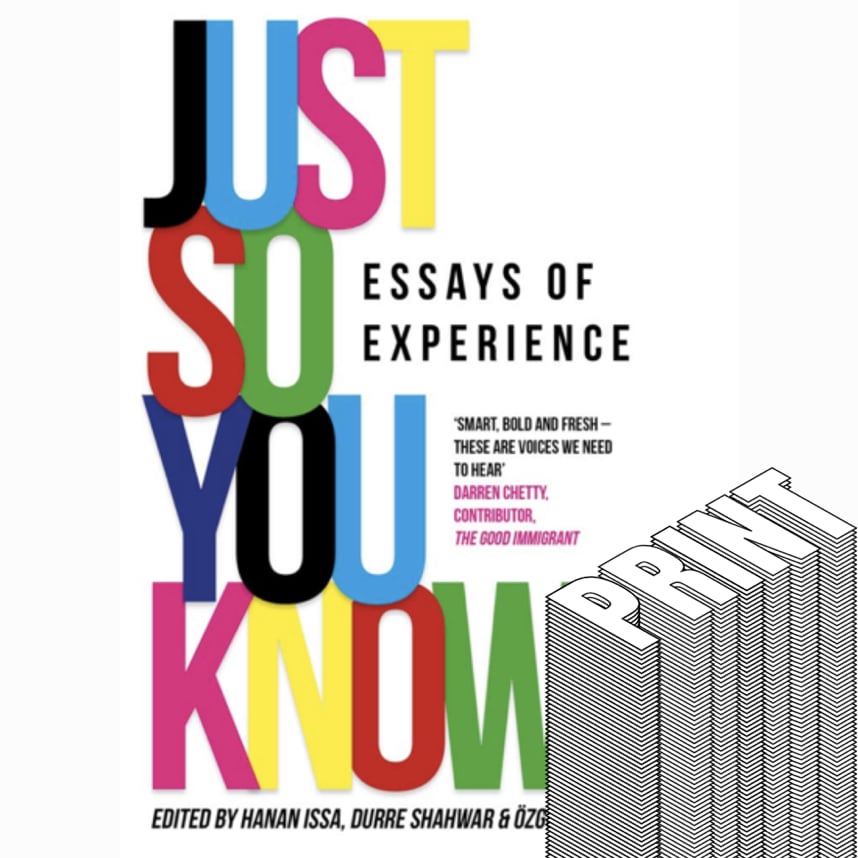
It is not often I pick up a Welsh publication and find a glimpse of myself: and I see shards reflecting my life in most, if not all, the sixteen narratives that make up Just So You Know. Throughout the text feelings resonate, be it in experiences sometimes very different from my own. Just so you know, this book got under my skin, eliciting a spectrum of emotions from me throughout my reading.
This collection presents as a mosaic of marginalized yet dynamic and courageous fresh voices. These are articulations of personal experience, and covering topics from Welsh language, bilingualism and language politics, visible and invisible disability, cultural heritage, and to issues of self-identity around the themes of ‘race’, religion and im/migrant experiences.
These are topics too often ignored, rarely spoken about in the open; or when they are, often as an equality, diversity and inclusion consideration, rather than part of the mainstream normative narratives. This constant ‘othering’ is hindering and damaging our understanding of each other, exacerbating our lack of humanity (towards each other). The narratives are exemplified by the times we are in.
Just So You Know is not filtered to make the reader comfortable, but personified – with visceral vulnerability, brutal and sincere honesty and sharp wit to provoke reaction and invoke reflection and consideration around how we approach the inclusion of some and exclusion of ‘others’. These narratives will make you sit upright with discomfort and take notice of some uncomfortable truths.
The beauty of this book also is that you can start from anywhere (like I did) as each contributor has their own subjective take on their experience.
We learn about Dafydd Reeves’ experiences of Bipolar Disorder. This is reimagined through the character Rhwngdaubegwm, meaning two polarities, ‘a bard [who] also suffered from changes of mood, from the most soaring euphoria to the most miserable pits of depression’. Reeves provides unique insight on how the medium of fairytale, folklore, mythology and religion can shed light on mental health from the perspective of the person experiencing Bipolar Disorder in the moment. Reeves’ work is a provocation to those gazing in on that moment – so that we can learn to show compassion.
Josh Weeks comes to a realization that he must take ownership of his OCD and begins writing letters to ‘Dear O’ as a way of acknowledging and embracing an intrinsic part of him. Weeks also shares the analogy of the snail and the stone as a way of explaining mental disorder to others ‘the amygdala is far too overactive… every time you feel danger or anxiety you crawl back into your comfort zone’ – again giving the reader some insight.
Kate Cleaver, as a mixed race person, opens up about her autism, dyspraxia and dyslexia and the numerous challenges she has encountered. This is depicted through her experiences of riding a trike. Paralympic medalist and member of Team GB, Ricky Stevenson, who lives with cerebral palsy, recognises the quiet satisfaction of being in a unique position as a marginalised person practicing an overlooked sport: boccia, but this comes at a cost.
No matter what part of the world we hail from, the romanticised imagery of the woman of the water is familiar to us all (think Ophelia, or the Lady of the Lake, or of ‘mermaids, sirens and selkies’). Kandace Siobhan Walker’s mythical narrative on this theme takes a sharp turn as she unravels her own reality of domestic abuse: ‘something about me had the look of a lady of the water,’ she opines. This melodic essay entwines Welsh and Kenyan folklore – it will captivate your heart and leave you utterly breathless.
The theme of water continues as Grug Muse cleverly ‘muses’ on the fact that the language of ‘water is changeable’. Our relationship to water depends on where we are with it – whether ‘drinking from it, sailing on it or even drowning in it,’ or as ‘ice’, but she also relates it back to her own experience of ‘swimming’ between languages. Muse beautifully and effortlessly also introduces us to the metaphor of ‘drowning’ and how it is used in the Welsh language with the most powerful example in Wales of the drowned Welsh village that hauntingly reveals itself and reconnects its significance to the recent upsurge in debate around Cofiwch Dryweryn.
The theme of being between languages continues. Isabel Adonis recollects whilst she was growing up that there was no distinction between speaking English or Welsh. It was just a blend of ‘language without real borders’ but her relationship to bilingualism changed upon entering academia and the division between Welsh speakers and the others became apparent and unnecessary. Adonis also observes how ‘children [are] inadvertently being taught how to be nationalist to identify with being Welsh’, thus creating a series of others – the English and the ethnic minorities. This process exacerbates racial bias and tensions – un/knowingly, un/consciously, but also unnecessarily – which is a huge concern in our current climate of them and us.
Bethan Jones-Arthur semi comically shares an essay about coming out in a pub in the valleys. She delivers with great humour, but also tentatively, cautiously and with trepidation. Intoxication – drunken or otherwise – can either make people bold and brave, or vulnerable and powerless. No matter what your desired outcome, your guard is down ready for acceptance or rejection: the reader cannot help share in the pride and the elation.
Dylan Huw offers deep reflections on queer history. He explores how a gay person has privilege to be free as others in the past did not, but that many still do not have that freedom continues to agitate and perturb him. He sees ‘faces of white middle class gay men in the media and prestigious public life all the time… I am no more minoritised than a straight person who otherwise shares my demographic profile’. I’ve not heard anyone recognise this privilege of freedom contrasted to those who are still not free so clearly. It is powerful to read.
Privilege is also echoed in Derwen Morfayel’s essay. Morfayel observes that white Europeans experiences [in Wales] for the most part have been positive, at least until the EU Referendum. ‘The difference is that I, Invisible Immigrant, can choose,’ she states. By immigrant ‘they always mean another foreigner, one who dresses differently or has darker skin, a heavy accent… There is a hierarchy of nationalities when it comes to foreigners, where certain nationalities are more tolerable’. The privilege of invisibility, of whiteness, Morfayel demonstrates, affords you insight into the bigoted and conscious biased minds and prejudiced attitudes of those who say ‘we don’t mean you’. The notion of invisibility ties nicely to a long literature of black identity.
Taylor Edmonds focuses on the intersections of her identity between her sexuality and being a person of mixed heritage. She reflects on a pivotal moment in her life when she had to tick an ethnic monitoring form at school to herald her diversity and select a box. She realised on appearance she was ‘mostly white, but not completely’. Edmonds also divulges with sincerity on benefitting from ‘white passing’ privilege afforded to by her light skin in a way some members of her family or other black and non-black people of colour are not. She has found her voice through her writing and performing poetry as a way to dissect and interrogate the marginalisation of LGBTQ+ people of colour.
Nasia Sarwar-Skuse recollects what home means to her. Hers is a common diasporic sentiment. She is forced to reflect on compartmentalised childhood memories, and on experiences of racism and prejudice from the Thatcher years that are resurfacing once again within post Brexit Britain. As a child she ‘didn’t have the language then to tell them that different was not wrong’, but now finds a voice through her writing. She examines how precarious a notion citizenship is for im/migrants, especially for Black and non-black people of colour. As the Windrush generation are finding out, the spectre of the revoking of citizenship reminds you still never quite belong.
Identity is the key theme of the remaining works. I felt the knot in my stomach twist as I wrongly preempted the direction of Iraqi Welsh writer Ruqaya Izzidien’s narrative. I was truly blown away, and though it did not echo what I was expecting, it resonated. The ‘projection’ people have of you in your childhood and the continuous imposition of that stereotype can shape, impede and render your development, your direction, your dreams and potential. She writes ‘I mourn who I could have been had my identity not been forced upon me, what would I have done with that freedom to choose’. Indeed, what has Wales lost out on?
In Ranjit Saimbi’s heartfelt examination of Sikh culture, religion and identity politics all collide. ‘What if, when you explain something to me, I still disagree?’ Saimbi ponders: ‘What if to me, it feels like I am becoming a lie’. Saimbi is caught between two different worlds, an exile from where those you love are, but from where you don’t quite want to belong. This resonated with me profoundly.
Sarah Younan, born in Germany, of mixed European and Middle Eastern heritage, recounts her upbringing in Kenya where she was viewed as mwungu (Swahili word for white person). However, she comes to the realisation whilst at a German School in Nairobi that she wasn’t quite White either. In learning how to navigate the complexity of her identity and sense of belonging, Younan garners valuable and astute insight into the residual effects of post colonialism. This lingers and is demonstrated, for example, in the actions of tourists, or in those who purport to immerse themselves into ‘African culture’. Younan’s narrative certainly makes for interesting reading around the concept of ‘white saviourism’.
Finally, Özgür Uyanik is a Turkish writer based in Wales. Uyanik speculates on his early gravitation towards Turkish literature written by women. He examines his relationship with his father posthumously and his reconnection to wider Turkish literature. As a writer he highlights his vehement refusal to pander to the expectations of publishers in becoming tokenised as ‘the other’ simply in order to get publication like numerous Black Asian and minority ethnic people before him. He refuses to be a diversity quota. He is not criticising the writers who pursue this route, but the publishers who dilute authentic artistic and creative expression for white mass consumption. He refuses to become ornamental, occidental and incidental.
Just So You Know – of which Özgür Uyanik is one of three co-editors – is an emblematic book that has unearthed uncut gems. It is time for publishers to platform and amplify authentic voices that have always been here: or should I say ‘hear’ in case you were just not listening…
Just So You Know is compelling reading for those with a genuine interest towards building a truly inclusive Wales.
PULL QUOTES
Just so you know, this book got under my skin, eliciting a spectrum of emotions
It is time for publishers to platform and amplify authentic voices that have always been here: or should I say ‘hear’ in case you were just not listening
I felt the knot in my stomach twist as I wrongly preempted the direction of Iraqi Welsh writer Ruqaya Izzidien’s narrative