
The digital home of Welsh culture.

Clarrie Flavell: ‘Lighting the Roman Fires’

Audio Description

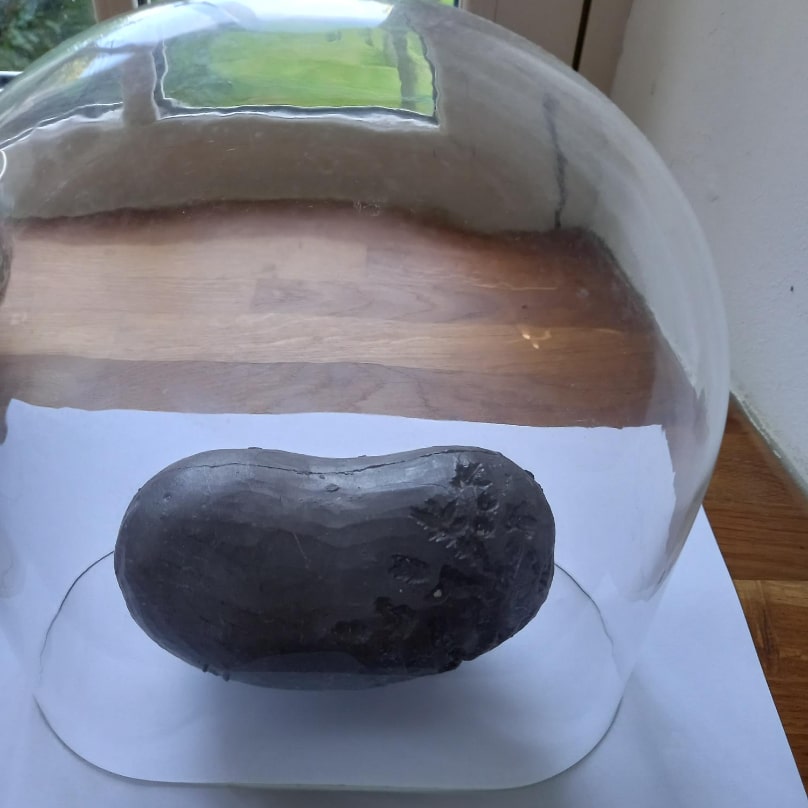
On the plinth in front of you is a small sculpture, under an oval glass dome, which is more than twice its height.

Made of lead, it takes the form of a bean shape, with a deep grey lustrous glimmer to its surface.

It stands on a short stump – a relic from the casting process, with the curved back facing downwards, and its two ends facing upward.

It weighs over 4.5 kilo, or nearly 10 and a half pounds, yet at around 3 inches high and 5 inches long, it could be contained by your palms, when your hands are placed together.

Scattered over its surface, though mostly confined to a patch on the lower half of it, are indentations that represent the abstract form of meadow flowers. The remainder of the sculpture appears smooth, yet it faintly shows the traces of the methods and materials that created it.

I live amongst the hills south of Abergele, on a Roman road. Just behind the house are fields that contain the lead mines where they once extracted ore.

The Romans mined several metals in Britain, laying waste to swathes of what had been once pastureland.

Peppered across a swathe of local hills are evidences of vanished mineshafts, visible now only upon OS maps – the fields themselves having recovered long since.

They’ve returned to rich rolling pasture, dotted with fragile meadow flowers that dance briefly in the wind before being entombed in the hay crop, to feed next winter’s cattle.

This bean is a symbol of this suspended life, holding it’s promise of growth yet to come, and imprinted upon its surface are the excavated imagery of the wild flowers.

It was made from cast lead over an open fire in my garden, over looked by two mineshafts that yielded the same ore, all those centuries ago.

SHARE