The digital home of Welsh culture.

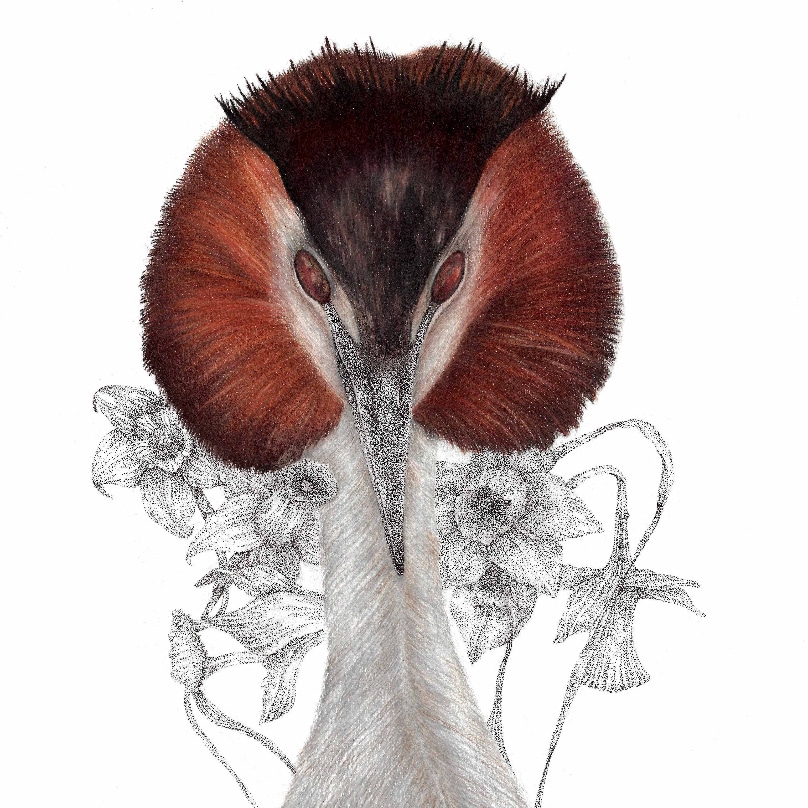
Cerys Knighton: ‘Great Crested Grebe, Daffodils’

Audio Description


From the bottom of the page the bird’s body stretches up into her long neck, rendered in pencil in shades of warm grey and hints of pale reddish brown. At the top of her neck, the bird’s pale face looks out to the viewer with two big, bright red eyes. The centre of the face has a dark brown stripe stretching up from her beak to the top of her head with thin strands of feathers stretching upwards. The bird’s head is encircled by a thick ruff of orange, red, and dark terracotta feathers. Her beak stretches down between the two sides of the ruff, rendered in ink pointillism in black and grey ink – a technique of layering individual ink dots. Six daffodils, also in ink pointillism, encircle her neck. The first daffodil on the left-hand side peeks out from under the ruff, stretching outward. The second reaches out from around the bird’s neck and looks up into her face. The third daffodil sits below, looking out to the left-hand side. On the right-hand side, a daffodil looks towards the bird’s neck from underneath the ruff, with a second, mostly hidden daffodil peering out from beneath the first. The final daffodil has bent at the stem, facing down. The stems wind from around the bird’s neck, tangling slightly with one another. The drawing is just under A3 size, set in a white mount and a bronze frame with embossed leaves.

A recent piece of exhibition visitor feedback was that my artworks were “too much” in terms of exploring my experiences of bipolar disorder. I found this specific phrase interesting because of the way bipolarity is often conceived as presentations of too much – too much emotion, too much energy in behaviour. This social view often makes me feel like I need to monitor and tone down the way I react and show emotion around others – don’t cry, don’t celebrate too much, don’t laugh too loud, and don’t ever raise your voice. That feedback kept coming back to me as I was working, and I was frustrated that it was making me want to tone down my artwork because my practice had become important to me as a way to express emotion. My PhD research into the historic conceptualisation of bipolarity revealed its characterisation by either an abundance or absence of energy in high and low mood states. Researching this made me think about how I use my art practice to navigate my own extreme shifts in energy – from a way to channel the “too much” through creative expression, to a way to reignite sensation amid an absence in states of depression. These pieces reflect on that state of seeking to reignite energy and rediscover creative fire by contrasting textures of ink pointillism and pencil, and by looking for moments of fire igniting in different bodies.

SHARE