
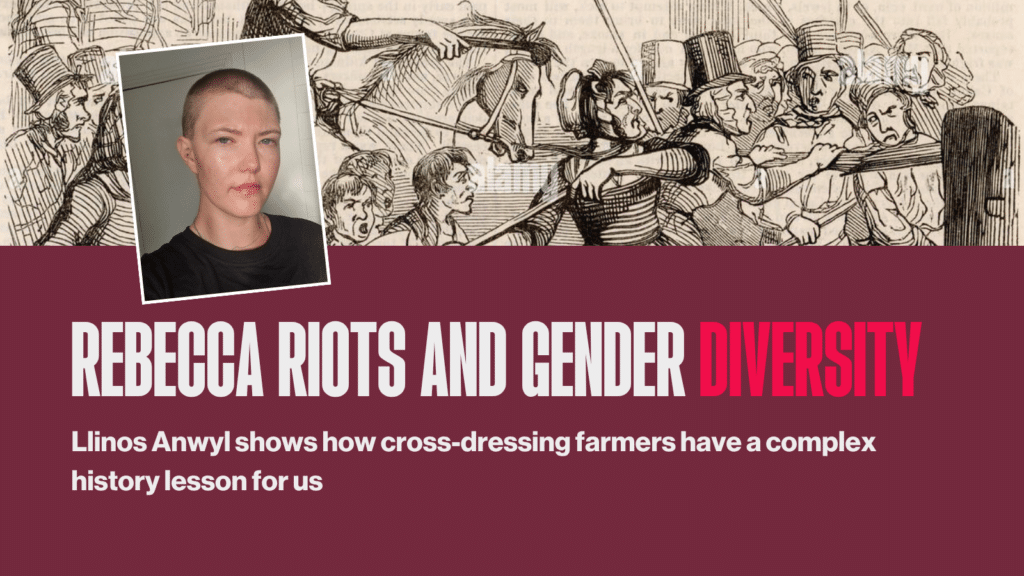
In the 1830s and 1840s, large parts of rural west Wales were shaken by a series of uprisings – with protesters disguising themselves as women – now known as the Rebecca Riots. It’s easy to look back at this, with a queer lens – but if we do, the nuanced learnings for our community are more complex than at first glance.
Farmers and labourers, living in poverty, were pushed to breaking point by toll gates erected by turnpike trusts. These trusts, often controlled by landowners and investors far removed from local life, charged people repeatedly simply to move goods, livestock, and bodies along roads that were meant to serve them.
In practice, the tolls functioned less as maintenance fees than as extraction. With little money and few routes of appeal, communities organised through collective action instead. Toll gates were destroyed, toll keepers intimidated, and authority briefly suspended. These direct actions were embedded in local networks of obligation and mutual recognition.
What makes the riots distinctive is how they were carried out. Participants wore dresses, bonnets, and petticoats, sometimes invoking the biblical figure of ‘Rebecca’. Encountering this moment framed as queer history can feel intuitively compelling. That reading is understandable. However, it misses what the riots actually show.
What the Rebecca Riots reveal is not that gender was being contested in a modern sense, but that it could be temporarily rearranged without loosening the order that held it in place.
Gender variance here functioned tactically, rather than expressively. It appeared disruptive, yet remained intelligible. As a result, disruption did not necessarily disturb regulation.
The cross-dressing involved did not operate as an identity. Rather, it worked as disguise; protecting anonymity, enabled coordination, and drew on cultural forms already recognisable within the community. Crucially, it did so without calling masculinity itself into question. The tactic succeeded because it repeated gender in a distorted register. Ritualised without stepping outside the terms that made it legible.
This is where historical context matters. Wearing clothes of the opposite gender was not alien in Welsh communal life. Seasonal customs and folk performances had long made space for gender inversion within tightly bounded conditions.
These practices bent norms without undoing them. Gender play existed, but it was contained within a temporal context, because of this, once the riot ended, the social order could reassert itself without difficulty.
And it did.