
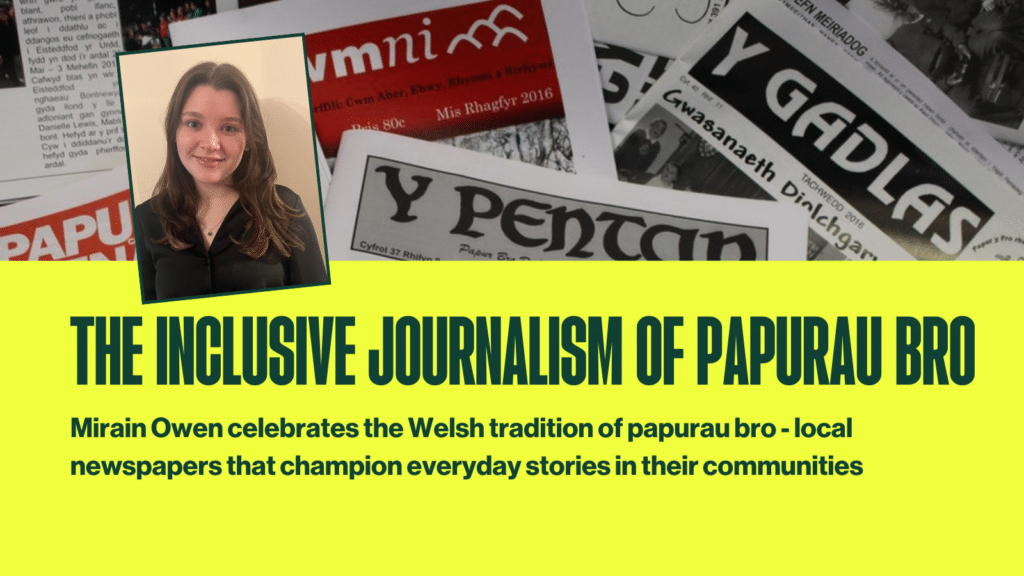
Gossip has a bad reputation. It’s whispered, side-eyed, dismissed as trivial or cruel, something to be risen above rather than understood. We’re told it’s petty, unprofessional, unworthy of serious attention. But gossip, at its core, is how communities stay connected. It’s how we share knowledge, pass on warnings, celebrate joy, and stitch ourselves together through story. Long before journalism had mastheads and bylines, people spread the news about who’d had a baby, who’d died, who was struggling, who’d done something quietly brilliant. Local Welsh community papers, papurau bro, are gossip given dignity. They take the everyday stories of ordinary people and give them space to be appreciated.
Papur Bro Wilia is my local papur bro. It formed a routine part of my month: skimming through its pages to find pictures of myself, my friends, or familiar faces from the community. Before I was ever involved with it, I was in it; a small photo, a short paragraph, a mention of a second-place finish in a local public speaking competition. Nothing earth-shattering, but Wilia treated these moments as if they were worth remembering. In a colonised, minority language nation, where we have repeatedly been told that our stories are unimportant, that speaking Welsh publicly is nothing worth writing about at all, these publications are even more important. From the Blue Books to the Welsh Not, generations have been taught shame, and that shame lingers. Papurau bro offer something quietly healing, even in the slightly embarrassing photos printed in a paper that gets thinner with every issue. Wilia has a way of celebrating the small wins, the kind that rarely make it beyond a school hall or community centre, and in doing so, made them feel huge. It gave children the excitement of being able to say, “Mam, I’m in the paper!!”
Papurau bro also hold space for grief, for remembrance. For marking the passing of people who would never be written about anywhere else, but whose absence would be felt deeply in pubs and chapels and at bus stops. They report on new after-school clubs with the same seriousness as they do anniversaries of loss. That balance, the joy and sorrow is not accidental. It reflects the logic of community.
“Inclusion is often framed as access to elite spaces: national newsrooms, major platforms, prestigious bylines. Those things matter. But inclusion is also about being seen where you already are. About your life being considered worthy of record without having to be exceptional, tragic, or controversial. “
I first started helping Wilia Abertawe with social media almost accidentally. I remember a meeting where the question on the table was whether the paper could even continue, and I volunteered without really thinking it through. I couldn’t imagine my Saturdays without that ritual of flicking through the paper, slipping into the bychanfyd Cymraeg it created. Page after page of Welsh events, Welsh speakers, Welsh life. For a moment, it felt like reading about a completely Welsh city. I never stopped to question whether that image was partial or idealised; it feels real, because it is real. Maybe not the whole truth of Abertawe, but a truth we so rarely get to see written down. There is something comforting in being reminded how much Welsh continues to be a lived language, even if it doesn’t always feel visible day to day. A lifestyle and journalism so underground that the majority of the population aren’t aware of its existence – which acts as its weakness and strength.
That’s the thing about papurau bro: they are built on passion. They are mostly run by volunteers, sustained by people who already have too much on their plates, and motivated not by clicks or profit but by a sense of responsibility. Responsibility to a place, to people, to memory. In many ways, papurau bro feel like the epitome of devolved broadcasting, even though broadcasting itself is still not devolved in Wales. In the absence of formal powers, communities have taken matters into their own hands, creating something almost super-devolved: hyper-local, volunteer-led, democratic and accountable to the people it serves. In an industry that increasingly rewards speed, scale and spectacle, papurau bro insist on slowness. They insist on names being spelled correctly. On getting the details right because the details belong to someone you might see in the Co-op tomorrow. That intimacy is what makes them, I think, the most inclusive form of journalism we have.
Inclusion is often framed as access to elite spaces: national newsrooms, major platforms, prestigious bylines. Those things matter. But inclusion is also about being seen where you already are. About your life being considered worthy of record without having to be exceptional, tragic, or controversial.
When we talk about the future of journalism in Wales, we have to start talking about these papers. Not as quaint relics or training grounds for “real” journalism, but as models of what journalism can be when it is rooted, relational, and accountable. They show us that journalism doesn’t have to shout to be heard. It can listen. It can notice. It can gossip kindly, carefully, and with purpose.
Gossip keeps communities alive because it acknowledges that people care about one another. Papurau bro formalise that care. They archive it. They pass it on. They make sure that a child’s achievement, a neighbour’s death, a new club, a difficult year, a shared laugh, all have a place to land. And in a world that so often tells marginalised people that their stories are too small, too local, too ordinary to matter, that might be the most radical thing journalism can do.
Mirain is a Law student from Swansea, who is now studying in Manchester. You can follow her on Instagram.