
We’re a collective of artists, storytellers, community organisers, facilitators, creators and journalists.
We found each other as we glanced around at a media industry crumbling at the feet of our communities. We locked eyes, and in doing so, caught glimmers of light, greenshoots of hope, and began to see ourselves better in the inspiration of each other.
We ducked underneath the surface, quieting the noise of mainstream perpetrators of capitalism, racism, patriarchy, ableism, transphobia, genocide and ecocide. Audre Lorde’s insight was front of mind: “the master’s tool will never dismantle the master’s house”. So we resisted isolation, competition and individualism and grabbed onto each other like mycelium.
We set out to build a commons together – to tend shared soil that we might grow from, to bear fruit that we might nourish each other with, to grow practises of collective storytelling that could be at the heart of a transformed society. We held tight and said: if we want life-giving stories, we need life-giving practices. Our storytelling commons for transition is what followed.
Megan Lucero, People’s Newsroom co-steward and contributor.
The Commons
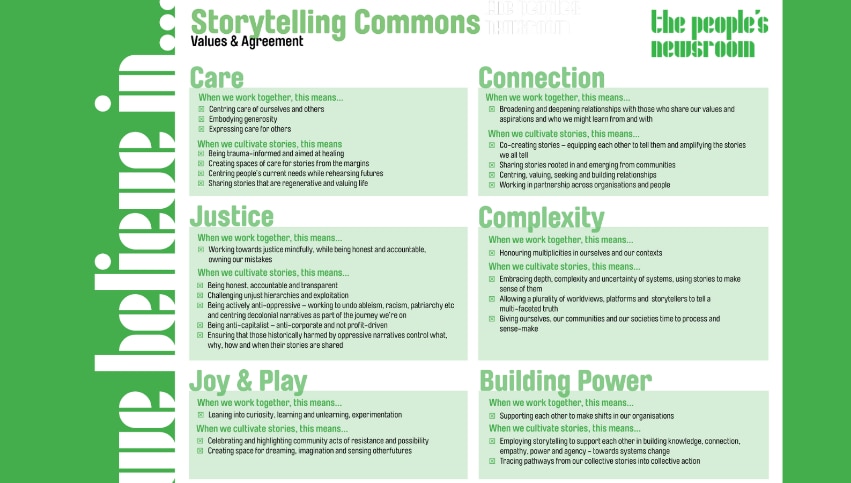
We, the initial People’s Newsroom collective*, came together in Sheffield in November 2023 inspired by the practice of commoning and hopeful that it could be applied to storytelling. A commons is a collective resource which is sustained and cared for by the people who rely on it. In order to build a commons together, we had to start to act as a community, with shared values and practices for living out those values. These are pictutred above.
A just transition for storytelling
In coming together, we found two central, interconnected aims that connected us and guided our work.
1) We’re a storytelling collective working towards regenerative futures for our communities. We’re not brought together not by content type, organisational structure or demographic. We’re organising ourselves based on values. We move beyond storytelling practices of community-centred co-creation and give it direction. We are joining organisers from the environmental justice movement in building, what they coined, a “just transition” (away from extractive economies and towards regenerative ones). Specifically, we are interested in co-creating with others, frameworks, practices and stories that can lead us towards futures where our planet, community care and economies are regenerative.
2) We’re seeking transition through a commons. Today, media and commons feel at odds when placed next together but news, information and stories are inherently (and have a history of being) shared, in a commons. We are approaching the just transition through emergence but one foundation thing we know is that we want, and need, to approach this through commoning.
|
We’re looking at our unjust systems |
|
|
where we are… |
but want to be… |
|
Failing to meet basic human needs while also exceeding ecological limits |
Meeting a social foundation for human prosperity and holding us within our ecological ceiling |
|
Harmed by and enabling: capitalism, racism, patriarchy, ableism, transphobia |
Creators of perpetual offerings of care in non-extractive relationships with community and land |
|
Isolated from each other, unable to see the big picture with cultural emphasis on individualism and competition |
Interconnected, interdependent and commoning with each other |
Collective, ongoing learning
We know the future is already among us. There are many people in big and small ways sharing mutual aid, practising care and interconnectedness and supporting communities in counter-cultural ways – that is what brought us together in the first place! So we knew we wanted to start with learning about each other’s community care practices and how they can lead us to transition.
We spent six months of 2024 gathering and learning from each other lessons on commoning, on infrastructures of care, doughnut economics, generative storytelling, shifting power in journalism, community investment and longevity (what it looks like to tell a story over four years!) and using physical space to not simply serve information gaps but connection ones too.
Here’s our first draft of our ‘transition of how’:
Story sharing
Alongside our learning sessions, we held ‘story-sharing’ sessions where we could practise with each other our evolving approaches to commoning and storytelling.
This time together influenced new work, like Now Then’s Honest Conversation series, Right to Thrive series, pieces on shifting wealth, queer Palestinians, neighbourhood mapping and on a community land trust as well.
We gathered and began to put into words what we’ve been learning and dreaming up together, to articulate and craft a guide for ourselves (and others) of what the stories of a just future might look like. Here is that draft:
What from our learning and aspirations resonated with you? What would you add to our transition framework?
Want to join us in learning, practising and enabling new ways of serving our communities and enabling a just transition through a storytelling commons?
Get in touch! peoplesnewsroom@weareopus.org
*Initial coalition of People’s Newsroom organizations and individual contributors:
AM (Alun Llwyd)
Civic Square (Lou Byng and Charlotte Bailey)
Greater Govanhill (Rhiannon Davies)
MAIA (Tianna Johnson)
National Theatre Wales (Rachel John)
Now Then Magazine (Sam Walby, Phillipa Willits and Sam Gregory)
Opus (Megan Lucero, Shirish Kulkarni, Debs Grayson, Tchiyiwe Chihana, James Lock, also co-stewards)