
By Robert Harries and Kathryn Tann
‘Just like the cow jumped over the moon’
When Fitzcarraldo Editions founder Jacques Testard was buttonholed about the meaning of his press’s name, he reasoned it was a reference to the 1982 Werner Herzog movie chronicling the attempt by Klaus Kinski’s unhinged rubber baron to haul a gargantuan steamship up and over a muddy hill in the Amazonian basin. An insane, borderline impossible pursuit, no doubt, and for Testard a perfect metaphor for attempting to run a successful literary endeavour.
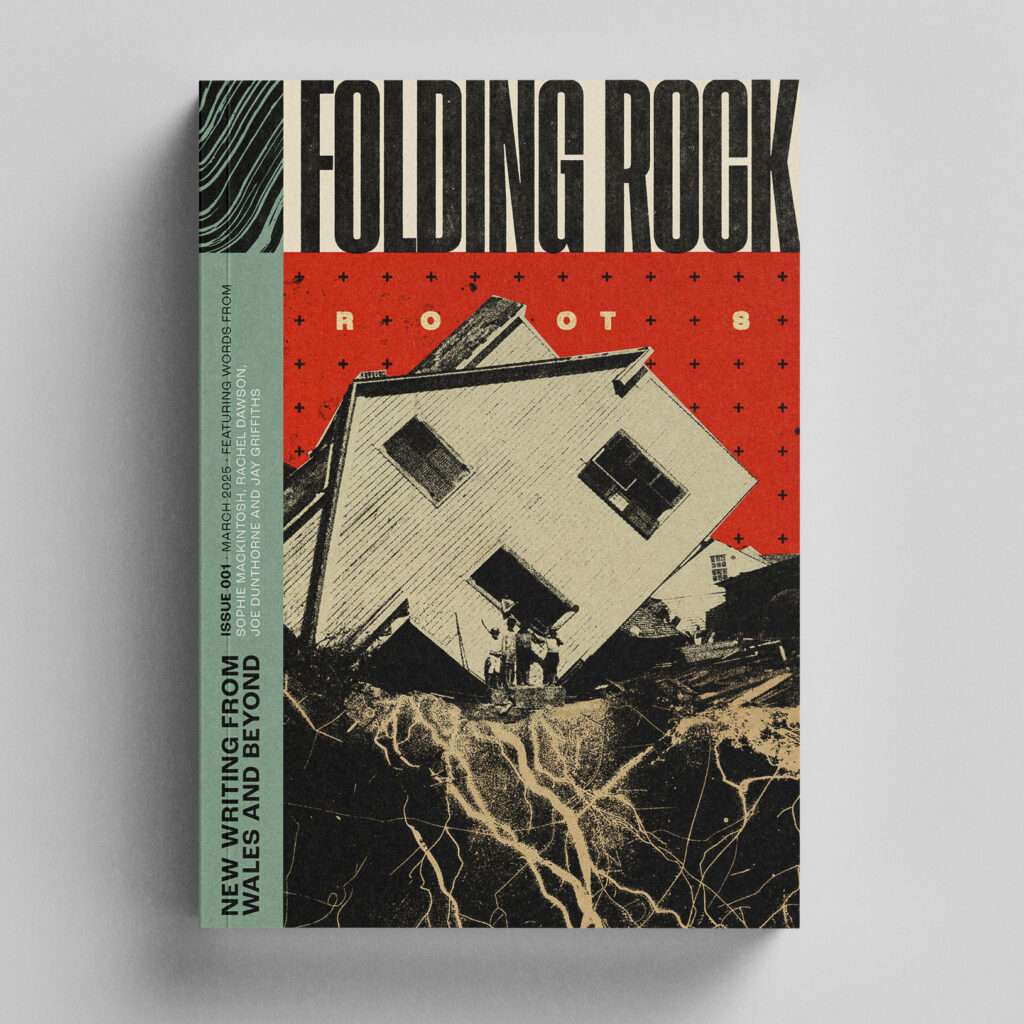
For me, ‘Folding Rock’ is a name cut from the same cloth. Conceived by my co-editor, Kathryn Tann, it was initially intended as a reference to Wales’s rich geographical association with, and reliance upon, rocks and minerals, particularly the country’s layered Orcovician formations. However, I must confess my mind immediately leapt to the oxymoronic unfeasibility – even futility – evoked by the phrase. Scarcely known for being the most malleable of substances, to attempt to actually fold a rock – or, say, run a literary magazine in the fiscally troubled, artistically crowded twenty-first century – would at first appear to be a fool’s errand. However, you only have to glimpse once more at the page-like creases and layers in the epochs-old stone to be reminded that what at first seemed unthinkable perhaps is possible with time – and maybe just a little pressure – after all.
That said, like rock, a name can crumble at the slightest scrutiny if there is not genuine heft or substance beneath its exterior. So what substance lies beyond Folding Rock’s facade? It has been a long-harboured belief of mine, shared by numerous Welsh or Wales-based writers and publishing professionals encountered in my eleven-plus years in the industry, that the country is significantly lagging behind the other UK nations in the literary stakes. To take an admittedly simplistic measure of success, amid our Celtic neighbours (for England’s dominance is too undeniable to be worth comparison), you have only to travel back to 2020 to find the last Scottish winner of the Booker Prize in Douglas Stuart’s Shuggie Bain – the nation’s second – while Ireland boasts six recipients, the most recent of which coming in 2023 with Paul Lynch’s Prophet Song. And that’s not even to mention the commercial phenomenon that is Sally Rooney, whose first two novels opened the floodgates worldwide for a new generation of young Irish talent. Wales does boast the accolade for having the first female winner of the Booker in Bernice Rubens – albeit all the way back in 1970 – but has barely grazed the upper echelons of the UK’s eminent literary prize since, with the most recent of a few exceptions being Sophie Mackintosh’s debut, The Water Cure, in 2018. (We’re thrilled to say Sophie graces the pages of this issue with the stunning ‘Lacrimosa’.)
For a nation as steeped in lexical and lyrical heritage as ours, this is nothing short of depressing, particularly as the talent is undoubtedly there. Indeed, I have seen and read enough in my editorial career to believe we stand on the precipice of a new golden age of contemporary Anglo-Welsh writing, as indie-published works such as Joshua Jones’s acclaimed Local Fires – shortlisted for both the Dylan Thomas Prize and the Polari First Book Prize – and Above Us the Sea, a moving paean to Cardiff’s queer scene by the Polish writer (and ex-inhabitant of the capital) Ania Card, attest to. These authors deserve to be discovered and read by a significantly larger audience than they currently command, but for this to happen, Wales needs to firmly step out of the shadows of its more prominent bedfellows and stand as a literary nation before the eyes of the UK – and indeed the world – with resolute confidence, pride and, dare I say it, a healthy sense of iconoclasm.
This, as they say, is where we come in. Fundamentally, Kathryn and I set up Folding Rock to provide a clear pipeline of quality talent development, editorial mentorship and, perhaps most crucially, a prominent, country-leading platform for writers to showcase their work. And quite the showcase it is. Clad in the fruits of Matt Needle’s exquisite art direction, this first issue presents fourteen outstanding pieces that explore differing perspectives on the concept of ‘roots’ – to us an obvious inaugural theme seeing that, with these pages you hold, we’re simultaneously anchoring our own foundations in the metaphorical soil. On the fictional side of things, six writers – from established literary heavyweights (Sophie Mackintosh and Joe Dunthorne), to emerging names (Anthony Shapland, Joshua Jones and Philippa Ball Lewis), to fresh talent seeing their fiction in print for the first time (Maya Jones) – have examined our chosen theme with skill, imagination and originality to craft a half-dozen tales ranging from the unsettlingly uncanny to the heartbreakingly real.
All that remains to say in this, my debut editorial, is: thank you for coming on this journey with us, for supporting new writing and helping us in our quest to establish Wales as a leading cultural nation. We genuinely can’t do it without your support, and we’re endlessly grateful for your taking a chance on us as we strive (if I may return to my Fitzcarraldian analogy) to forge our ‘great opera in the jungle’.
England, Scotland and Ireland have Granta, Gutter and The Stinging Fly respectively as periodicals synonymous with their best and brightest authorial stars of the future. Wales now has Folding Rock.
—Robert Harries, January 2025
Continue reading here