
We’re in Wrecsam (Wrexham, North Wales) for Eisteddfod, the annual celebration of Welsh arts, language and culture held in the city for only the second time in almost 50 years. The city centre is a-buzz with shuttle buses to the site, Welsh creatives of all stripes in the shops and tourist magnet The Turf Hotel pub made famous internationally courtesy of Emmy Award-winning Welcome to Wrexham. Gruff Rhys is minutes away at William Aston Hall, part of the Glyndwr University, visible from Wrexham AFC football club bought by Hollywood good guys Ryan Reynolds and Rob McElhenney.
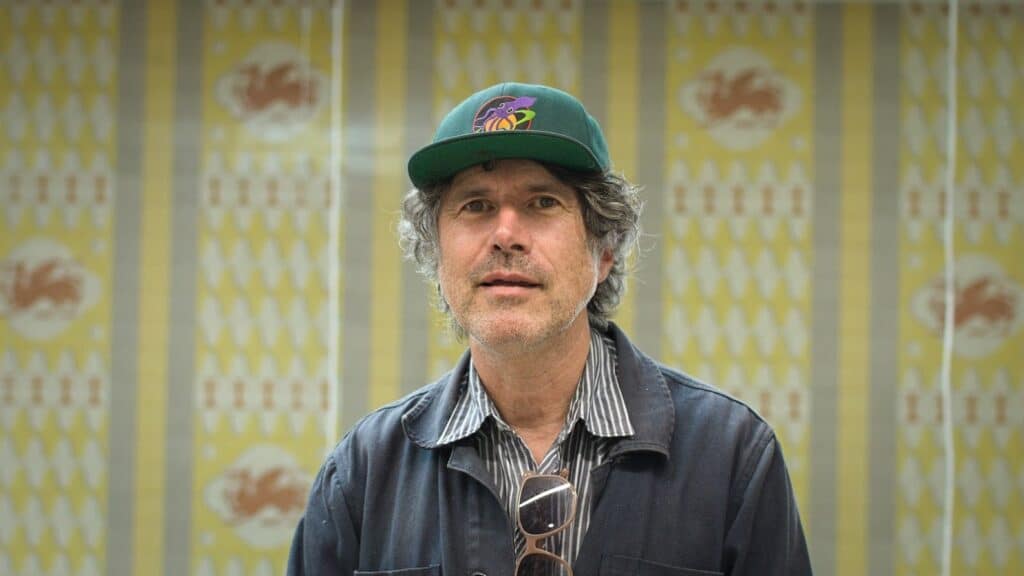
Inside the Hall’s reception a tile mural from ground to ceiling repeats red Welsh dragons, designed in 1950s by Chilean-born to Peggy Angus to represent the flow of learning within the university. Of Scottish parentage, Angus persisted when her modernist style went out of fashion and her very existence as a woman artist made her a triumphant minority. Gruff is very taken by the mural happy to admire the subtle but strong repetitive pattern as we take photographs. We find a safe sanctuary in a gallery space on the first floor to talk, mural in view.
Days previous, he wrapped up a tour marking the tenth anniversary re-issue of his American Interior album. Eleven years since original release if you want to be pedantic, but last year was a busy one. Because of American Interior, those both inside and outside Wales were educated about John Evans, a farmhand from Snowdonia who in the late 1700s travelled from the country over to the other side of the Atlantic. The victim of fake news centuries before it got trendy, Evans went in pursuit of a rumoured Welsh speaking tribe in America.
He died aged 29 and disappointed in New Orleans, but the even more well-travelled three foot tall felt puppet of Evans taken on international tour by Gruff – complete with educational Power Point presentation – has a more comfortable conclusion. ‘Gone back home’ as Gruff describes it with a smile. Returned to the John Evans exhibition in Antur Waunfawr near Caernarfon. ‘They’ve had him for a decade. I borrowed him.’
Back to the present and Gruff’s new record Dim Probs (No Problems) his fourth solo album recorded entirely in Cymraeg (Welsh) is out soon. Pang! the collaboration with South African electronic artist Muzi was the most recent in 2019 and Dim Probs is different again, acoustic pop folk songs with instrumentation added as seen and felt fit to nurture each into full bloom. Recorded In Bristol ‘informally’ as he puts it, Dim Probs isn’t lo-fi as such but no big polished affair like last year’s Sadness Sets Me Free with its ambitious orchestral arrangements.
I’m always reacting to the last record. I had these scratchy guitar songs that I thought were worth recording but I didn’t want to over arrange them. I was trying to keep it minimal,’ he says. ‘I had an album’s worth of songs I could play on an acoustic guitar, so I thought maybe that’s all it needs. And then it was a process of exploring and timekeeping, I put a crude drum machine down and then “maybe it needs a drone to fill in the bottom end” and “maybe I’ll allow myself one electric guitar”. Most of the songs I managed to keep my discipline!’
He beckoned in long-term friends and collaborators Kliph Scurlock, Osian Gwynedd, Huw V Williams and Gavin Fitzjohn willing and able to contribute and mould the record. ‘I’m really lucky, I have amazing musicians in my square mile. It’d be a travesty to not have more records in the world with them not playing on. The world’s a better place.’
Thematically Dim Probs is dark, the title heavy in irony, or is it sarcasm? A bit of both, maybe. Existing in such a state is a long way from the place we reside in contemporary times, what with the anger, discomfort and painful unease of 2025. We’ve been taught since forever that life will get easier, and newer generations have it better than ones past but that theory’s gone to shit, folks. So Dim Probs is here to tell the stories of today, ‘Taro #1 + #2’ deals in death, ‘Chwyn Chwyldroadol!’ weeds, ‘Cyflafan’ war and ‘Acw’ pestilence. It’s like all the plagues are descending. Or have descended and make merry as we fight fires.
‘We’re living in a really heavy time,’ Gruff replies simply. It’s a melancholy record to fit. ‘I was listening to a lot of 1980s Welsh language music recorded on four-track. I spent a period trying to compile music from that era and if you listen to anything intensely it comes out in your music. There was a really fertile period of quite dark electronic music in the 1980s in Wales, so I was listening to a lot of that stuff and when I listen to the record it sounds bit to me like Welsh language music being regurgitated. Like other things I’ve grown up with like Endaf Emlyn. I can hear his influence here and there. The songs are acoustic folk songs.’
It’s bleak,’ he laughs, then clarifies. ‘I don’t think musically I’m bleak. I enjoy melodic pop.’
Links with decades past are omnipresent on the album, nostalgic 1980s vintage electronics. A gentle stroll with Space Invaders is the God Is In The TV take on ‘Dos Amdani’ . A 1970s Japanese drum machine is on every song, and 1980s electronic drum pads when necessary. ‘Nothing’s programmed really I just hit play on the drum machine and added some live electronic percussion,’ he comments, making it all sound so simple.
The first single from Dim Probs ‘Chwyn Chwyldroadol!’ (Revolutionary Weeds) is economical with instrumentation but crammed full of melody and heavy with sentiment, the chorus translating as ‘Weeds for some, gold for others’.
‘What is a weed, Gruff?
‘It’s a plant.’
A revolutionary weed?
‘I suppose a weed that transforms a habitat and brings joy, like dandelions. It’s in praise of holistic weeds. It’s shocking what’s discounted as a plant, a justifiable plant.’
A metaphor for so much.
He’s saying the record is melancholic and that’s true for sure and it leaks into the music itself. ‘Slaw’ carries Joe Meek vibes, the piano on ‘Cân I’r Cymylau’ pings at the weary heart strings, but with that emotion comes also beauty. ‘Gadael Fi Fynd’ is hauntingly pretty, ‘Saf Ar Dy Sedd’ is a country/bossa nova hybrid, ‘Dim Probs’ is sung as if a lovingly delivered nursery rhyme, ‘Slaw’ guitar-led instrumental, ‘Acw’ a jazzed-up Morricone show stopper. We pick up on a sense of fun despite itself; ‘Chwyn Chwyldroadol!’ has Cate Le Bon and H Hawkline on backing vocals and having a good time by all accounts if you listen close enough (‘they were having a laughing fit. It’s a plain old laughing fit. I like it, it puts a smile on my face!’), the duo also providing a response to his call on ‘Pan Ddaw’r Haul I Fore’.
The show in Wrecsam tonight is organised by Welsh language campaigners Cymdeithas yr Iaith. ‘Saf Ar Dy Sedd’ (Stand On Your Seat) on Dim Probs is the story of Cymraeg activist Toni Schiavone’s refusal to pay an Aberystwyth parking fine in 2024 unless the letter issuing the fine was provided to him translated from English. Public bodies are legally obliged to provide Welsh translation in Wales, but private companies are not. Schiavone’s reasoning for not paying his bill was to expose that inequality.
‘Unfortunately the company were in their right to refuse to send him a letter in the Welsh language which is why he needed to go to court so that was exposed. He could then become part of the conversation of implementing more serious rights for Welsh language in the private realm. It’s a long process, a lot of people have been going through this process since 1970s, often direct-action campaigns to make Welsh more visible and give it an equal status. It’s absurd, that,’ explains Gruff.
Of ‘Saf Ar Dy Sedd’ he jokes about the fully seated venue ‘Well, there’s seats tonight! Try it out for the first time,’ and somewhat joyfully the audience gets up and dancing to the bop that is ‘Taro #1 + #2’. Gruff Rhys fans live outside the law, but politely. The other artists on the bill Griff Lynch from the Welsh Music Prize-nominated Yr Ods, newly announced winner of the Welsh Language Album of the Year 2025 Ynys (‘Dylan’s very talented, he’s made some great records’), and 2024 Triskel Award recipient WRKHOUSE all sing in Welsh, translating any English songs from respective back catalogues.
Gruff’s notoriously supportive of emerging Welsh artists, and mentions L E M F R E C K winner of last year’s Welsh Music Prize who performs in English and made a powerful speech at the ceremony in Cardiff about the importance of representation. ‘He was great. Good speech. Very good. Very good band too.’ Pys Melyn shortlisted for the award supported him on tour last year and in Birkenhead (where the Eisteddfod was held in 1917, fact fans) the day after we talk he describes them as the best rhythm and blues band in the world right now.
Cymdeithas yr Iaith have been putting on Welsh language gigs since Gruff first played in bands. ‘A lot of things we take for granted, bilingual signs and bilingual banking, bilingual shops they are responsible for, it’s through their campaigning that politicians have felt pressured into implementing these rights gradually over the years to make Welsh is a far more visual language today than when I was a teenager,’ he says. ‘Unfortunately I’ve seen big negatives as well.’
The decline in the number of Welsh language communities for one. ‘But equally I can go into a supermarket anywhere in Wales and there’s bilingual signs for everything. That’s very emotionally heartening I have to pinch myself sometimes, it’s so different. So visible now. And that’s all been through campaigning, often direct campaigning, nonviolent. Ghandi-style tactics.
‘That’s what’s horrific now. We find ourselves with a government are cracking down on protest classifying protest as terrorism is truly chilling,’ he adds, the governmental reaction to groups like Palestinian Action contributing to that widespread bleakness.
Dim Probs is released on Mogwai’s label Rock Action Records. There isn’t the same amount of commercial pressure with this as with his non-Welsh records, he says. ‘I’m not the most organised person in the world so any help I can get by organised people especially people I trust musically I’m extremely grateful for. There’s a lot to be said for putting things out yourself, but that effort sometimes is superhuman. Sometimes all I can deal with is melody and lyrics!’
We’re loving the videos accompanying and illustrating singles from Dim Probs so far. To illustrate ‘Saf Ar Dy Sedd’ there’s a spaceship in video by BAFTA-nominated Cornish animation company Spider Eye in there with Pete Fowler’s now familiar Dim Probs dog. ‘That’s a UFO. It’s the end of times floating through the debris of late capitalism.’ The others are filmed on reels somewhat hilariously spare leftover film from Righteous Kill, Quartet, and Bourne 5. It all sounds very glamorous, Gruff.
‘It has nothing to do with the films, but these films always end up with spare reels. I said where do you get this bit of film from, and it was Quartet by Dustin Hoffman.…’
You did an interview not long ago where you talked about the difficulty in being a professional musician singing exclusively in Welsh so it’s never something you could consider giving up. Even the late Geraint Jarman who released so many records in his lifetime, had to have a day job.
‘No one’s going into releasing records in the Welsh language to do anything beyond making music in the Welsh language. But I think that’s true for almost all music now. Maybe in the past when music as a commodity was similar to oil or a really valuable commodity like in the 1970s but it’s not anymore. People have always made music and always will. And musicians are usually the last people to ask about the value of what they do.’
What does he make of ancient Welsh ‘cythraul canu’, (devil singer) belief theory?
‘It says all musicians have a competitive demon in them. That creates competition between musicians. I suppose singing turns people into competitive monsters.’
Has your demon got more sensible?
‘I dunno! It correlates with the devil myth. It’s the same idea. To become a musician, you give yourself to the devil. It’s maybe from an ultra-religious context; people were trying to ban harp music and get everyone to go to chapel.’
Gruff Rhys meeting the devil at the crossroads is quite an entertaining idea. Would pay good money to see that.
Speaking of the darker side of life again, how challenging is it to not depress the living life out of everybody on an album reflecting current realities? ‘Well sometimes that’s reassuring, given the gravity of the times we live in. Sometime you ned the reassurance to be reassured that times actually are really bad. Sometimes you need the bleak soundtrack that reflects how bad reality is. Sometimes it’s a relief to be buoyed up by more melodic music as well.’
‘It’s still in the realm of pop music,’ he concludes of Dim Probs. ’Three minute pop songs is something I’m still quite attached to.’
Dim Probs is released via Rock Action Records on 12 September.
Photo credit: Beverly Craddock