Artist of the Month is a feature where we put the spotlight on the incredible work of one of our members.
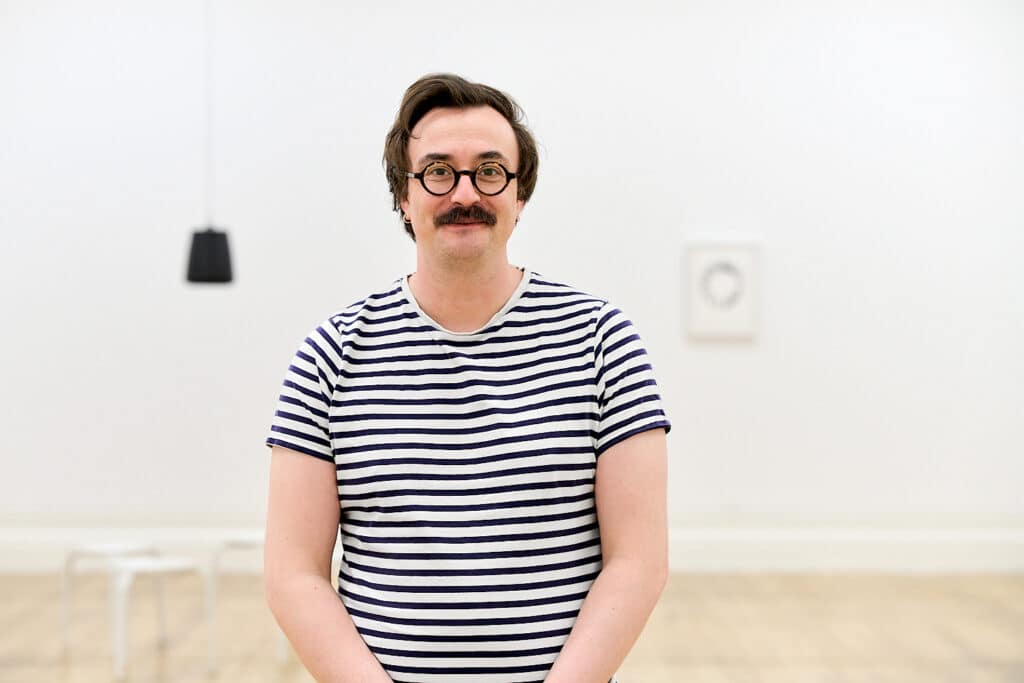
Our Artist of the Month for April is Paul Eastwood! Read the feature below:
I am a visual artist living and working in Wrexham, Wales. My new exhibition, ‘Unreadings’ (2026), currently on at Mostyn Gallery, is the first time I’ve explored the tension I experience between reading and writing as someone with dyslexia.
The inspiration that has led me to build this body of work has stemmed from my early school experiences of attending Welsh-medium education and later navigating between the English and Welsh languages. Bilingualism and being brought up in a non-Welsh language home have informed a lot of my art practice over the past 10 years. Placing myself in the middle of the two languages and living on the periphery of Wales (Wrexham) has influenced aspects of my work.
Previous works have envisioned disembodied voices occupying broken objects in abandoned museums in the video work ‘Segrgair’ (2017) and imagined a hybrid Celtic language sending out a message to a distant future in ‘Dyfodiaith’ (2019). Considering my struggles with reading and writing in either language, I surprise myself with how much of my work is about language. Although the arts sector has made many reasonable adjustments to applying for opportunities and grants that don’t rely only on written applications, nevertheless writing in English or Welsh has become a crucial part of my practice.
My solo show at Mostyn Gallery, ‘Unreadings’ (2026), starts with three steel-framed Perspex interruptive text panels. English on one side and Welsh on the other; neither are translations of each other, and the texts start fairly normally apart from the middle panel where both texts merge into one. This reflects how I feel about writing and the muddling that occurs when reading and working between languages. The English panel explains: “This text exists both as an introduction to ‘Unreadings’ and as an artwork. It reveals the invisible labour behind writing: the cycle between artist, editor, spell-check, friend, software, and back again. For me, dyslexia is not an isolated characteristic but a constant companion, shaping how meaning is formed, held, or slips away.”
The show consists of crumpled-up texts, knotted words, half-legible texts, spoken and sung narratives that are depicted in a suite of new drawings, four audio works, and a dual-screen sound and video installation.
The drawings emerge from an examination of text within historical painting, particularly medieval speech scrolls used to depict religious verse. These painted texts raise questions about access and legibility: who was able to read them, and for whom were they intended? It is likely that only a small, educated elite—wealthy patrons and members of the clergy—could fully access their written content. This tension between visibility and readability informs the drawings, which consider how text functions both as image and as language.
The drawings then shift into facsimiles of reading from a dyslexic perspective. Letters are tidied, scrunched, and partially concealed; sequences break apart or fold into one another. These altered forms reflect the instability of the reading process, where hesitation, pattern recognition, and visual shape all play a role. In doing so, they reveal the blurred boundary between reading a word and recognising it through its form and overall structure.
Four new audio works hang in the gallery space; these written texts are reflections on my childhood and adult experiences of education and navigating between the two languages. The overall theme for the writing is exploring those subtle differences in how one expresses oneself in each language, either through making work or day to day.
They are a first reading and a mashup attempt through the use of cut-up techniques. Fragments are written on stickers and moved across the page, partially obscuring and rearranging the words. This process reflects my experience of reading as someone with dyslexia. It foregrounds hesitation, misreadings, and the slow sounding out of letters, allowing the instability of the text to echo the lived process of reading.
Both collaborations with Samuel Barnes and Dr Angharad Harrop begin with texts that form the basis of the audio works. The texts “Copying”, “Bilingual”, and “Slow Reading” shape how movement and sound are developed. These texts influence the behaviour and rhythm of both the dancers and the music.
Steel structures act as stand-ins for the lines of a page. Here, the dancers become the ink on the page, creating marks across an imagined sheet of paper. Their movement echoes the flow of handwriting, but also its interruptions, pauses, hesitations, and corrections, mirroring the uncertainties that arise when trying to write words whose spelling I am unsure of.
The music, accompanied by a sung narrative, provides a loose structure for the dance. However, the composition also incorporates cut-up techniques that interrupt and obscure the natural flow and rhythm of the musician reading the written score. In this way, the performance mirrors the disruptions, pauses, and reconfigurations that shape my experience of reading and writing.
This new body of work reflects the ongoing tribulations that I incur when navigating the written world. Instead of ignoring it, I’ve used the thing I struggle with most to make my most beautiful work to date.
Sara Erddig (Dr Sara Louise Wheeler) and I will be in conversation at Mostyn gallery on 16th of May 2026. Please join us if you would like to learn more about the exhibition and its themes: https://mostyn.org/event/talk-with-artist-paul-eastwood-and-dr-sara-wheeler/
Supported and funded by Mostyn Gallery, Foundation Foundation and Arts Counicl Wales.
Image credits: Rob Battersby and Mostyn Gallery